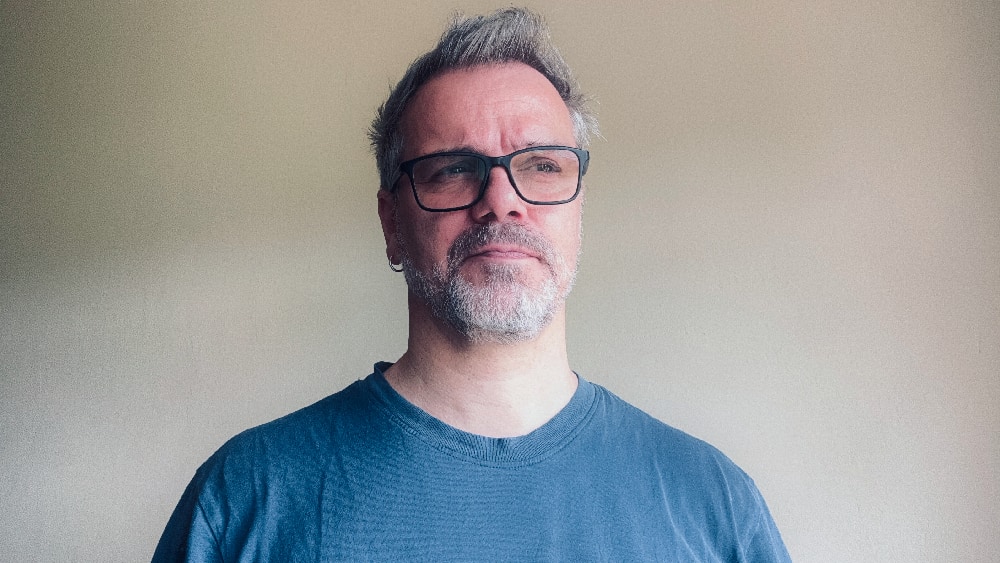
Selfie by A. N. D’Angelo – All Rights Reserved
· ★ ·
7 August 2026
A premise: for simplicity’s sake, consider “native speakers” as implicitly referring to those whose first language is English, and “non-native speakers” to those whose first language isn’t English.
· · ·
I knew well it would be hard. Native readers aren’t the most open community on this planet when it comes to translations. They didn’t grow up reading a great many translations, not as many as non-native readers did.
It isn’t their fault. At most, it’s a collective cultural responsibility, but the reasons at the root of the “problem” — which only becomes a problem when you’re a foreigner — are clear and partly justify that intellectual stance.
There’s a great abundance of writing by native authors — especially once you start talking about “genre fiction.”
We non-native speakers learn English — some more, some less, but all of us by now. It’s a necessity native speakers don’t have. If you’re an avid reader of genre fiction, it becomes a must, because little of what’s produced in English gets translated, especially if you’re looking for quality and depth in the vast cauldron of fantastical fiction in the broadest sense — unfortunately, commercial fiction wins hands down.
We non-native speakers aren’t better. We’re more open because the world pushed us to be.
I Don’t Like Lying to Myself
Reality is reality, though. I grew up reading more foreign authors than Italian ones, and my imagination was shaped by the great names in genre fiction. Not just Tolkien or Howard or Moorcock, but also — and in my case especially — Ursula K. Le Guin, plus all the other masters of modern fantasy, many great science fiction authors, a few great horror authors (I explored that genre less), and so on.
I read a lot before I turned thirty and everything was translated.
At seventeen, I forced myself to read in English because “one day I’ll need it,” I told myself. It took me an hour and forty minutes to read the first three pages of Dragonlance — hardly Shakespeare — with a dictionary beside me. I remember it as if it were yesterday.
Today I read in English and Spanish, despite being Italian. I’d like to read in French and German too, but I’ve decided three languages well are better than five badly.
Four years ago, or a little more, I decided that “the day I’ll need it” had arrived. I was wrong. I wasn’t ready and, although I’m proud of and satisfied with my English translation, I think there’s still plenty of room for improvement. It would be strange otherwise.
Four Years to Translate My Novel
Andrea, no one will read you, I kept telling myself.
I’ve always known it. And yet, after more than thirty-five years of a “career” as a writer of genre novels — mainly adult fantasy, but not only — I told myself something else too: Yes, it probably won’t work, but you’ve earned the right to try.
What does that mean?
It means I’m not taking anyone for a ride. That I’m doing things very seriously, as I’m accustomed to doing, with complete respect for readers. It also means I’m a mature writer who knows well what he’s doing. I could list the things I’ve done, but there’s no point.
The issue, the reason I’m writing this article, is the trust of native readers: I can’t win it.
Absolute silence.
My English Debut
At first, I told myself it would be too difficult to get my novel across. I write fantasy with literary ambitions, in the tradition of speculative fiction. I am, therefore, a niche author.
My novels have an intrinsic strength of their own, but I think few people would call them “commercial,” in the good sense of the word. They’re novels that challenge the reader, demanding attention and insight, because of their density, because they don’t say everything and because they’re anything but conventional.
On top of that, the debut deliberately presents itself deceptively, as though it were classic fantasy — with Dark Elves, gruff and burly Dwarves and Warriors.
It had the same effect in Italy in 2005, when it was published by the most important Italian genre publisher of the time, Editrice Nord. It divided opinion. But some people looked beyond appearances, and the novel even became a finalist for the country’s biggest national genre fiction award, coming second: the Premio Italia — which certainly isn’t the Hugo, the Nebula or the British Fantasy Award.
It isn’t classic fantasy, and the classic elements it contains should be read in two ways: they exist to be dismantled, they are there as a literary choice (I can’t explain precisely), in the shadow of the great masters. But it is and remains contemporary adult dark fantasy — if you really love definitions, which, however, stiffen what should instead be regarded as fluid matter and, for that very reason, wonderful.
I’ll stop here, because the article is already too long. What my novel is doesn’t matter. Besides, it would be better if readers discovered that without the author telling them.
The problem is that I can’t get anyone to read it, as I said.
Nothing. Nothing at all. Not even now that it’s free on Smashwords throughout July (the promotion has ended; the result was three downloads). It’s as if it had the plague. So I asked myself what else I was missing, because there has to be something I’m missing.
I think I’ve understood: the problem is Artificial Intelligence.
AI slop, as everyone calls it now.
They don’t trust you, Andrea, I told myself. They won’t even come near, because they think you’re another one of those people who used AI to translate a novel and decided overnight to call himself a writer. Another one of those people taking them for a ride, with neither talent nor craft.
Then, I told myself, give it a try. Explain. Once, because more than that makes no sense at all: if people prefer to live with their prejudice, you have no chance of changing their minds.
Besides, readers are free to choose whatever they like. That’s how it works. You already knew it would be incredibly difficult, Andrea.
Yes, but for all my efforts to be made pointless mainly because of Artificial Intelligence and the complete lack of trust it has created in independent authors, after Meta even stole from me (I’m on The Atlantic’s list, yeah), really feels like too much!
My Translation
During the translation, I used AI only as a native English teacher and consultant. What does that mean? Two things.
One.
There’s no better teacher than one who reasons things through with you using examples based on your writing. One quick example of how I used it: when I had a general doubt about how to translate a certain Italian syntactic construction I often use. Giving it your original paragraph along with your translation of that paragraph and asking a specific question was one way I used it.
The way it explains what’s wrong with your translation is incomparably more useful and clearer than any English grammar or syntax book could ever be — which, incidentally, I studied; but you all know that practice is worth more than grammar and I, alas, have never lived in an English-speaking country.
Mind you. It isn’t that grammar and syntax books aren’t authoritative and precise, but that they’re written for everyone, while I didn’t need to learn how to translate into English, but how to translate my voice into English.
That’s a far “easier” task than expecting to turn yourself into a “translator” in four years without undertaking a formal course of study. Translators are professionals capable of translating well any text you put in their hands. I have no such pretensions and, frankly, I don’t even claim my translation is on the same level as what true professionals would produce from my original text, if properly paid.
Exactly. There’s this small detail: I don’t have the money required to pay a real translator. Nevertheless, before starting again from scratch last year and finally managing to produce a translation of my own worth attempting a debut with, I also tried the native proofreader route, feeding him my translation and spending quite a lot of money. The result, however, didn’t seem good enough to me. A proofreader isn’t a translator: you pay them for extremely limited line editing, and they carry over every problem your poor translation introduced.
So I gave up two thirds of the way through and considered the money spent an investment in knowledge. Then I started again from scratch. Alone.
Two.
The speed and range of AI’s answers to your questions about the best term — noun, verb, adjective — to use in context are incomparable.
If you ask it for a synonym because you want to remove a repetition or, even more subtly, an annoying alliteration,* it gives you a wide range of choices and also explains why one works and another doesn’t, which is better and which isn’t, which word is obsolete, which is too modern for your fantasy voice, which is pompous and which is flat, banal, and so on.
For someone who has spent four years trying to raise their English to the level required to enter the market their novels were born for and should be aimed at, well, this is a gold mine.
* I still have plenty of room for improvement with alliteration, because in English it depends on sound more than spelling… and I think that still escapes me quite often.
The Truth Is This
Artificial Intelligence did not translate my novel. I translated it and used AI in the way I’ve explained to you, along with more dictionaries than I can even remember. I also asked native-speaker friends about specific issues where I couldn’t form a clear opinion even with AI—above all about literary prose choices.
I’ll say it again. The aim wasn’t merely to translate, but to transpose my voice, and I believe I’ve done work that deserves at least the readers’ curiosity, their consideration.
My voice, even in Italian, is quite recognizable, authorial, otherwise translating myself would have been far easier, I assure you.
I made at least fifteen passes over the text after the inadequate initial translation. In some parts, it was impossible to count them, because I simply couldn’t manage to feel satisfied and I must have gone past fifty…
It’s a real translation. Can it match what a good professional translator would have produced? Probably not. But I do think the effort I’ve put in over four years has borne fruit.
I hope someone who loves adult dark fantasy will want to give The Stronghold of the Silences a chance. And I thought this was the right time to do it, precisely because giving it a chance costs nothing, thanks to the Smashwords offer, where it can be downloaded for free.
If I can’t convince anyone even with this avalanche of sincerity, frankly, it’ll be time to fade away and smile at how much I’ve learned in these four years. Bitterly, perhaps, but smile.
Humbly, Andrea
· · ·
P.S.: Unfortunately, the Smashwords promotion has ended. If you’re still curious, you can always download the ebook sample. It should be more than enough to determine whether the translation meets the standards you expect. Thanks to Draft2Digital, the ebook is available from the major ebook retailers.
Amazon: https://www.amazon.com/dp/B0GTYPY3JL
UBL: https://books2read.com/u/4Aq5YK
· ★ ·